
ULIP vs SIP: Understanding the Key Differences Before You Invest
- June 22, 2025
- Posted by: jibankrnath101
- Category: Investment Strategies
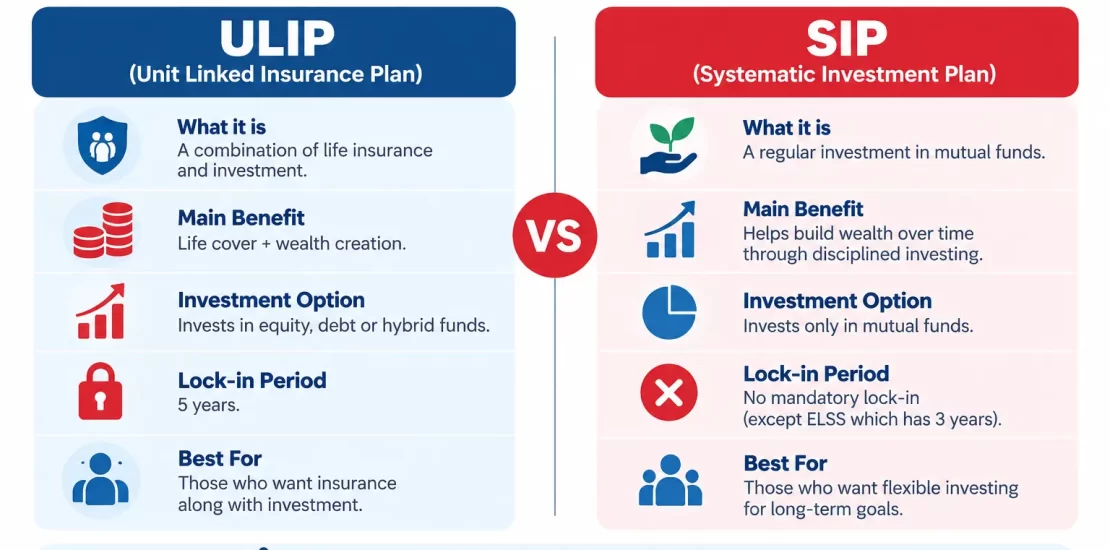
ULIP vs SIP: Understanding the Key Differences Before You Invest*
When people start planning for their financial future, two options they often come across are ULIPs (Unit Linked Insurance Plans) and SIPs (Systematic Investment Plans).
Although both can be used as part of long-term financial planning, they are fundamentally different. A ULIP combines life insurance with market-linked investment, while a SIP is a method of investing regularly in a mutual fund scheme.
So, ULIP vs SIP is not simply a question of which one gives better returns. A more useful question is:
What are your financial goals, and which structure is more suitable for those goals?
Let’s understand the key differences.
What Is a ULIP?
A Unit Linked Insurance Plan (ULIP) is a life insurance product that combines insurance protection with investment.
Part of the premium is used to provide life insurance coverage, while the remaining amount is allocated to investment funds according to the policy and the options selected by the policyholder.
ULIPs may offer different fund choices, such as equity, debt or balanced/hybrid options, depending on the product.
Because the investment portion is market-linked, the value of the investment can rise or fall with market conditions. Therefore, ULIP investment returns are not guaranteed simply because the product is an insurance policy.
Key features of ULIPs
- Combines life insurance and investment
- Offers market-linked investment options
- Fund choices depend on the particular ULIP
- Generally has a five-year lock-in period for linked insurance products
- Includes policy-specific charges and conditions
- Designed for long-term financial planning
The exact benefits, charges, fund options and conditions can vary between ULIP products, so investors should read the policy documents carefully before purchasing.
What Is a SIP?
A Systematic Investment Plan (SIP) is a method of investing a fixed amount into a mutual fund scheme at regular intervals, such as monthly. AMFI describes SIP as an investment methodology rather than a separate investment product.
For example, an investor may decide to invest a fixed amount every month in a selected mutual fund scheme.
Over time, regular investing can help create investment discipline. SIPs can also provide rupee-cost averaging because units are purchased at different market levels over multiple instalments.
However, SIP does not guarantee returns. The value of the investment depends on the performance and risk characteristics of the underlying mutual fund.
Key features of SIP investing
- Regular investment in mutual funds
- Can help develop disciplined investing habits
- Suitable for different financial goals and investment horizons
- Investment amount and frequency depend on the scheme/platform requirements
- Returns are market-linked
- Does not itself provide life insurance
ULIP vs SIP: Key Differences at a Glance
| Factor | ULIP | SIP |
|---|---|---|
| Basic structure | Insurance + investment | Regular investment in mutual funds |
| Life insurance | Included as part of the policy | Not included |
| Investment | ULIP funds | Mutual fund schemes |
| Lock-in | Generally 5 years for linked insurance products | Depends on the mutual fund; ELSS has a 3-year statutory lock-in |
| Flexibility | Subject to policy terms and conditions | Generally more flexible, subject to scheme rules |
| Investment risk | Depends on the underlying fund | Depends on the selected mutual fund |
| Costs | Policy and investment-related charges | Fund expenses and applicable charges |
| Main purpose | Combines insurance and investment | Regular mutual fund investing |
For ELSS, SEBI identifies a statutory three-year lock-in period.
Why Investors Consider SIPs for Long-Term Investing
SIP can be a convenient way to invest regularly without requiring a large lump-sum investment at one time.
For investors with long-term goals, regular contributions can help create a disciplined investment habit.
1. Regular investing
Instead of waiting for the “perfect” market level, investors can invest at predetermined intervals.
2. Investment discipline
Automatic or scheduled investments can make it easier to maintain consistency.
3. Rupee-cost averaging
Because investments are made at different market levels, the purchase price of units can vary over time. This is commonly referred to as rupee-cost averaging.
4. Long-term wealth-building potential
Market-linked investments can potentially grow over the long term, although there is no guarantee of returns.
Important Things to Consider Before Starting a SIP
A SIP is not automatically suitable for every investor or every financial goal.
Before investing, consider the following:
Market-linked risk
Mutual fund investments are subject to market risks. The value of your investment can rise or fall.
No life insurance protection
A SIP is an investment method. It does not provide life insurance coverage by itself.
Fund selection matters
The outcome of an investment depends significantly on the mutual fund scheme selected, its underlying investments, costs and market performance.
Investment horizon matters
Equity-oriented investments can experience significant short-term fluctuations. Investors should consider whether the investment horizon matches the risk of the chosen fund.
Costs matter
Expenses and applicable charges can affect the overall investment outcome.
ULIP vs SIP: What Should You Consider?
Instead of looking only at potential returns, consider several factors before deciding between the two.
1. Your financial goal
Are you planning for:
- Children’s education?
- Retirement?
- Wealth accumulation?
- A long-term financial goal?
- Life insurance protection combined with investment?
The purpose of the money should come first.
2. Your need for life insurance
If you need life insurance protection, remember that a SIP by itself does not provide it.
A ULIP combines insurance and investment, while a SIP is an investment method.
3. Your investment horizon
Both products can involve long-term financial planning, but their structures and conditions are different.
Always understand the applicable lock-in, policy term and withdrawal conditions before investing.
4. Your risk tolerance
Both ULIPs and mutual funds can involve market-linked investments.
The level of risk depends on the underlying investment choices.
5. Liquidity requirements
Consider when you may need access to your money.
A product with restrictions may not be appropriate for money that you may need in the short term.
6. Costs and charges
Don’t compare products only on projected returns.
Understand:
- Policy charges
- Fund-related expenses
- Premium requirements
- Applicable transaction charges
- Other product-specific costs
ULIP vs SIP: Which May Suit Your Financial Goals?
There is no single answer that applies to every investor.
A ULIP may be considered by someone who wants a product that combines life insurance with market-linked investment and is comfortable with the policy’s terms, costs and long-term structure.
A SIP may be considered by someone whose primary objective is regular investment in mutual funds and who wants to build an investment portfolio according to their financial goals and risk profile.
Importantly, these two options don’t necessarily have to be viewed as mutually exclusive. Insurance and investment are separate financial needs, and an individual’s overall financial plan may include different products for different objectives.
ULIP vs SIP: The Bottom Line
ULIP and SIP are different financial tools designed around different structures.
ULIP = Life insurance + market-linked investment
SIP = Regular investment method for mutual funds
The right approach depends on your financial goals, insurance requirements, investment horizon, risk tolerance, liquidity needs and understanding of the product’s costs and conditions.
Before investing, read the relevant product or scheme documents carefully and understand the risks involved.
Frequently Asked Questions
Is ULIP better than SIP?
Neither can be considered universally better. ULIP and SIP serve different purposes and should be evaluated according to an investor’s financial goals, insurance needs, risk tolerance and investment horizon.
Does SIP provide life insurance?
No. SIP is a method of investing in mutual funds and does not itself provide life insurance.
Can I invest in both ULIP and SIP?
Yes. An investor may use different financial products for different goals, depending on their overall financial plan.
Does ULIP provide guaranteed returns?
Market-linked ULIPs do not guarantee investment returns from their market-linked component. The investment value can fluctuate based on the underlying funds.
What is the lock-in period of a ULIP?
Linked insurance products generally have a five-year lock-in period. Specific policy terms should always be checked in the product documents. IRDAI’s guidance directs policyholders to the applicable regulations for ULIP lock-in provisions.
Does every SIP have a lock-in period?
No. SIP is a method of investing and does not itself impose a universal lock-in. The applicable conditions depend on the mutual fund scheme. For example, ELSS has a statutory three-year lock-in.
Disclaimer: The information provided on this page is for educational and informational purposes only and should not be considered investment, insurance, tax or legal advice. Mutual fund investments are subject to market risks. Please read all scheme-related documents carefully before investing. Insurance products are subject to the terms, conditions, exclusions and applicable regulations of the respective policy. Tax benefits and treatment are subject to prevailing tax laws and eligibility conditions.
Sources: Information relating to mutual funds, SIPs and direct/regular plans has been referred to from official sources including AMFI, SEBI and IRDAI.